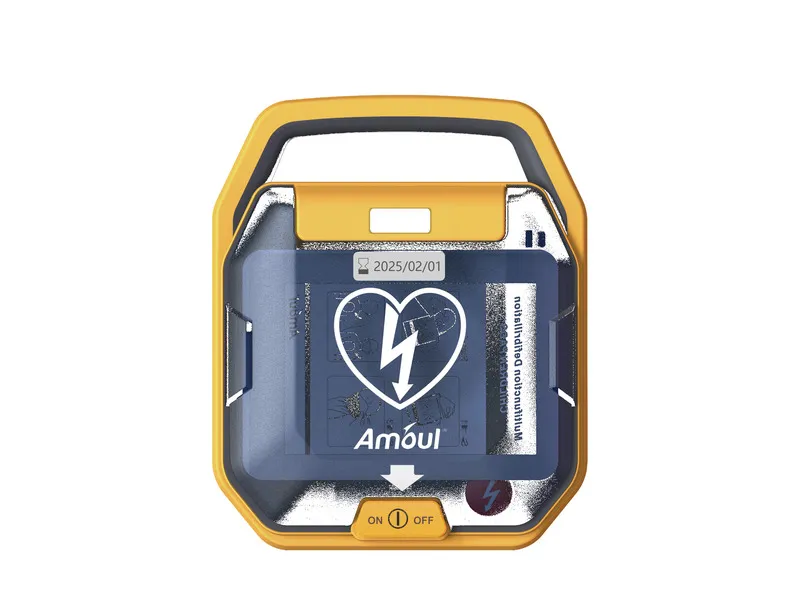
What is an AED?
An AED (Automated External Defibrillator) is a portable device used to treat sudden cardiac arrest (SCA). It automatically analyzes the heart's electrical rhythm and delivers an electric shock if it detects a life-threatening arrhythmia such as Ventricular Fibrillation (VF) or Ventricular Tachycardia (VT), restoring normal heart rhythm. According to the American Heart Association, using an AED with CPR within the first 3-5 minutes increases survival rates up to 70%. AEDs are designed for use by non-medical personnel with minimal or no training.
What does AED stand for?
AED stands for Automated External Defibrillator. "Automated" means the device automatically analyzes the heart rhythm, "External" means it is applied externally via electrode pads on the chest without surgery, and "Defibrillator" refers to the device that delivers an electric shock to the heart. In Thai, it is commonly called "เครื่อง AED", "เครื่องกระตุกหัวใจไฟฟ้า", or "เครื่องช็อกหัวใจ".
What does an AED do?
An AED analyzes the patient's heart rhythm and determines whether an electric shock is needed. If it detects Ventricular Fibrillation (VF) or Pulseless Ventricular Tachycardia (pVT), it delivers a biphasic electrical shock through electrode pads to stop the abnormal rhythm and allow the heart to reset to a normal beat. The AED only shocks when medically necessary — it cannot deliver an accidental shock to someone with a normal heartbeat, making it safe for anyone to use.
How do you use an AED step by step?
Using an AED involves 3 main steps: 1) Turn on the device and follow voice prompts — all AEDs provide step-by-step voice guidance, Amoul i-Series supports Thai language. 2) Apply electrode pads to the patient's bare chest as shown on the pads — one below the right collarbone, one on the left side below the armpit. 3) Let the AED analyze the heart rhythm — semi-automatic models prompt you to press the shock button, while fully automatic models (i7 Plus/i9 Plus) deliver the shock automatically. Continue CPR chest compressions while the AED analyzes.
What types of AED are there?
AEDs come in 2 main types: 1) Semi-Automatic AED — automatically analyzes heart rhythm but requires the user to press the shock button, suitable for trained medical staff and first responders. 2) Fully Automatic AED — analyzes and delivers the shock automatically without any button press, ideal for public spaces where untrained bystanders will operate it. The Amoul i-Series offers both: i7/i9 (semi-automatic) and i7 Plus/i9 Plus (fully automatic).
Where should AEDs be installed?
AEDs should be installed in airports and transit stations, shopping malls, hotels and resorts, offices and high-rise buildings, schools and universities, sports facilities and gyms, factories, and condominiums. The key principle is that an AED must reach the patient within 3 minutes — after 3-5 minutes of cardiac arrest, irreversible brain damage begins. Japan has over 600,000 AEDs installed nationwide, and the United States mandates AEDs in all airports.
Who can use an AED? Is a license required?
Anyone can use an AED without a license or medical training. AEDs are specifically designed for immediate use by bystanders in emergencies. Research shows that even schoolchildren can begin operating an AED within 90 seconds. In Thailand, the Emergency Medical Act B.E. 2551 (2008) provides Good Samaritan protection for those who render emergency assistance in good faith, so AED users are legally protected from liability.
How should an AED be maintained?
AED maintenance covers 3 key areas: 1) Check the status indicator monthly — a green light means the device is ready. 2) Verify electrode pad expiration dates — pads last approximately 18-30 months (2-3 years) depending on manufacturer. 3) Monitor battery life — batteries typically last 3-5 years. Amoul i-Series AEDs support AED Network Management for automatic remote status monitoring with alerts when parts need replacement. Thunder Venture Group provides battery replacement, electrode pads, and device inspection services.